 Fraunhofer Institute for Wind Energy Systems
Reliable testing of rotor blades to ensure the safe operation of wind turbines.
The rotor blades of large offshore wind turbines have now surpassed the 100-meter mark. This growth is pushing the material reserves to their limits. A thorough understanding of the complex mechanical behavior of composite materials under fatigue loading is therefore essential. Advances in production technologies and automation are necessary for the reliable and efficient manufacture of rotor blades of this size.
Thanks to its unique research infrastructure, Fraunhofer IWES is in a position to support the wind industry across scales and in all technical domains. The institute offers everything you need for the research and development of wind turbine blades – from full-scale testing of the rotor blades to micro-CT scans of fiber orientation, from innovative production technologies to the dismantling and recycling of end-of-life (EoL) rotor blades and much more.
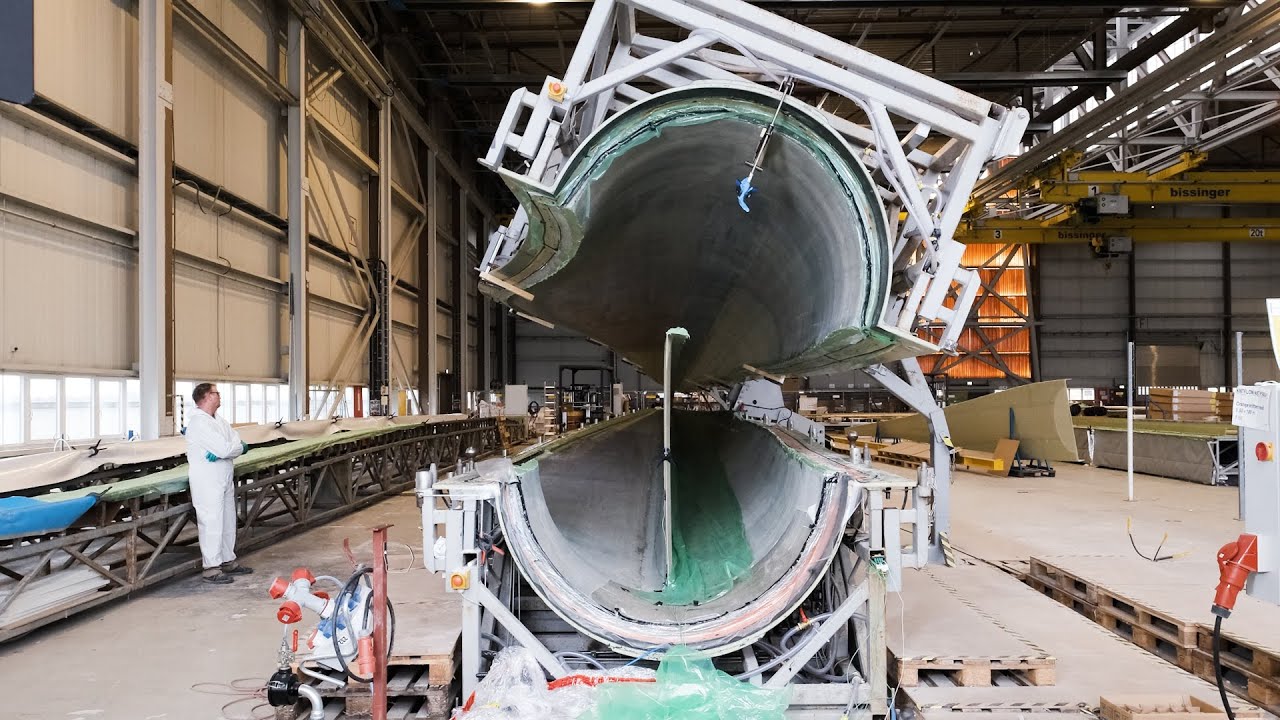
Research rotor blade production at Fraunhofer IWES
The rotor blades of wind turbines must withstand extreme loads during operation over 20 years and at the same time have a low weight. Therefore, only high-performance lightweight materials that fulfill the most demanding requirements in terms of both mechanical properties and cost can be considered for the manufacturing of these rotor blades.
At Fraunhofer IWES, we work closely with material manufacturers and rotor blade producers to harmoniously combine these different and sometimes conflicting requirements. Thanks to our unique testing and experimental infrastructure, which is specifically tailored to the wind energy industry, we can comprehensively analyze the suitability of materials both structurally and in terms of manufacturing technology.
In our Blade Maker demo center, we manufacture rotor blades and rotor blade components on a 1:1 scale in order to test manufacturing processes. We validate the performance of the materials through a variety of structural tests – from coupon level to patented subcomponent tests to sequential and biaxial full-blade tests.
Our in-depth understanding of rotor blade structure also allows us to evaluate the effects of material properties on structural design and the remaining service-life of existing turbines. Fraunhofer IWES thus acts as a link between various branches of industry and supports the development of innovative materials for rotor blade construction. In this way, we make a valuable contribution to industry and promote the rapid expansion of wind energy.
Fraunhofer IWES conducts root cause analysis of rotor blade damage from a neutral scientific perspective. This provides an independent, well-founded assessment of the underlying facts, enabling conclusions to be drawn about potential failure risks beyond the individual case. This analysis draws on a comprehensive understanding of the entire system, years of experience in rotor blade validation, and, in particular, a broad understanding of all aspects of development. This includes: materials, manufacturing processes, structure and certification, transport, installation, operation, possible repairs and dismantling.
Accurate prediction of the fatigue behavior of composite materials requires a deep understanding of the materials and manufacturing processes. While we naturally also offer standard material testing, our particular strength is the development of new test setups for specific requirements. In the Leading Edge Lab, we test systems for their rain erosion and ice performance.
Fraunhofer IWES offers the possibility to produce test specimens in the range from coupons to entire rotor blade. This supports the testing of the processing of novel materials and ensures a smooth market introduction. In addition, the production of large components enables the validation of manufacturing-centric material models, including advanced models of curing kinetics.
Automated production processes are always a case-by-case decision for wind turbine blades. Achieving the optimal balance between investment costs, production rate, flexibility of production, operational costs, and the in-field reliability of the blade is particularly important.
Fraunhofer IWES provides support in the search for customized solutions for manufacturing challenges. To do so, we combine and integrate existing commercial products, taking our customers’ specific technological developments into consideration. The BladeMaker demonstration center is an ideal development environment for both us and our partners.
In addition, Fraunhofer IWES also works independently on process developments such as the variable paste shoe, which has been patented and is available through license agreements with our partners.
When it comes to dismantling and recycling wind turbines, the discussion revolves around one of the component in particular: the rotor blade. The aim of the research at Fraunhofer IWES is to ensure high-quality recycling that preserves many of the fibers’ positive material properties and those of the sandwich materials. Therefore, the institute has developed a concept for an economically viable disposal strategy for rotor blades and is examining individual methodical steps.

